



Courtney Seraile, Admin
Mental Health Advocate





Sankofa: Learning from Our Pan African Past

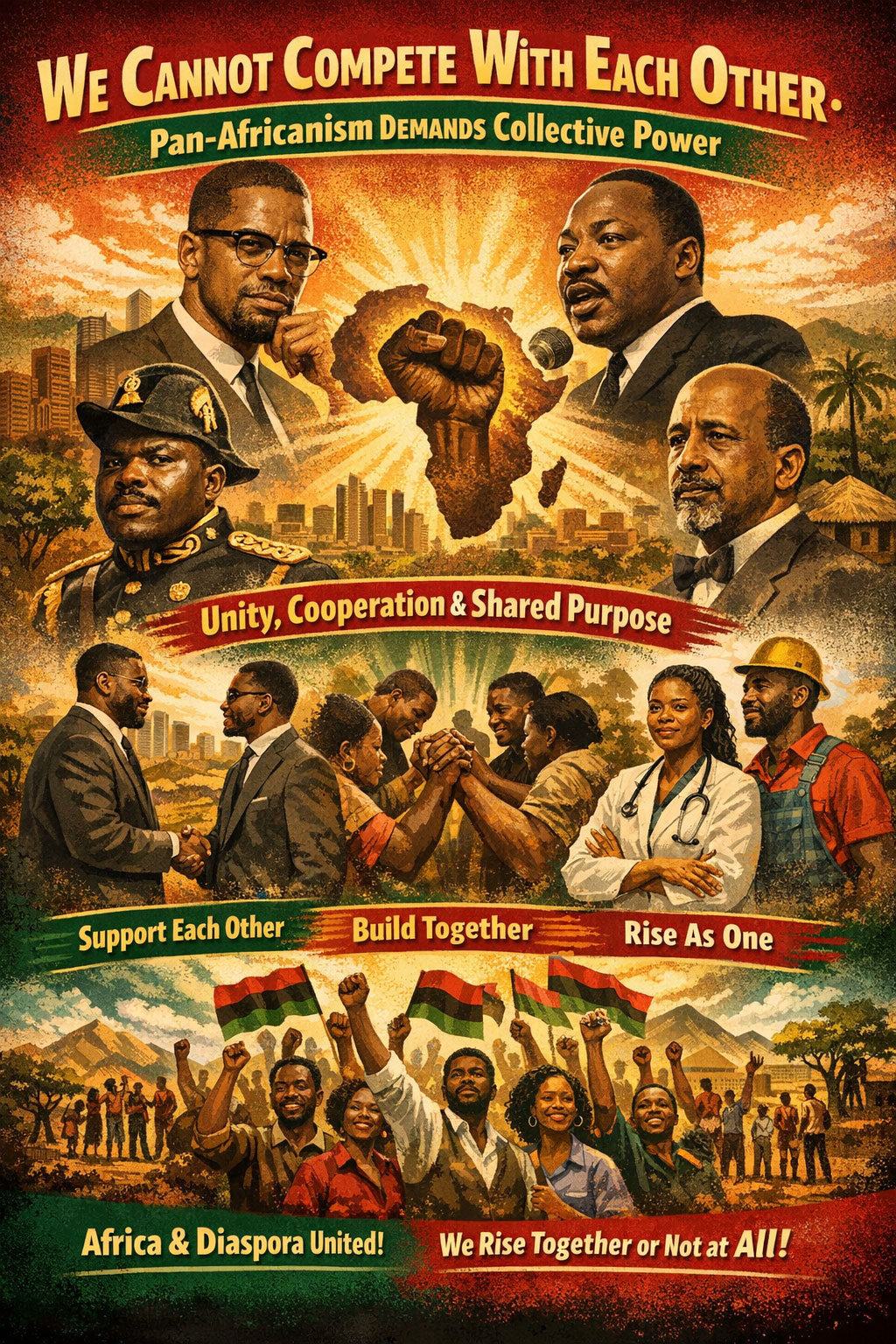
In every era of our struggle, our greatest threat has never been to each other; it has been the systems that benefit when we are divided. Pan‑Africanism teaches that the liberation of African people worldwide depends on unity, cooperation, and shared purpose. Yet too often, we fall into the trap of competing with one another instead of building with one another.
History gives us clear examples.
Malcolm X vs. Martin Luther King Jr.: A False Divide
Malcolm and Martin are often presented as opposites: the militant vs. the dreamer, the fire vs. the peace. But this narrative hides the truth. These two men were not enemies. They were two strategies of the same struggle.
- Malcolm X said, “We need more light about each other. Light creates understanding.”
- Martin Luther King Jr. said, “We must learn to live together as brothers or perish together as fools.”
Both understood that Black liberation required unity. Their differences were tactical, not personal. And near the end of their lives, their visions were converging Malcolm moved toward global human rights, and Martin moved toward radical economic justice.
Imagine if they had been allowed to work together fully. Imagine the power of their combined influence. That is the power we lose when we compete instead of collaborate.
Marcus Garvey vs. W.E.B. Du Bois: A Conflict That Cost Us
Garvey and Du Bois were two of the most brilliant minds of the 20th century. Yet they clashed publicly, Garvey calling Du Bois elitist, Du Bois calling Garvey dangerous. Their disagreement became so intense that it weakened both movements.
But look deeper:
- Garvey wanted global Black economic independence.
- Du Bois wanted global Black political and intellectual advancement.
These goals were not opposites. They were two halves of the same liberation.
Their conflict became a lesson: when we fight each other, the system wins. When we unite, the world shifts.
Pan‑Africanism Rejects Competition Among Us
Competition is a tool of capitalism and colonialism. It teaches us to see each other as threats instead of partners. But Pan‑Africanism teaches something different:
- Your success is my success.
- Your business strengthens my community.
- Your victory expands our collective power.
We cannot afford to treat each other like rivals. Not in business. Not in politics. Not in culture. Not in the diaspora. Not on the continent.
Our ancestors built movements by lifting each other, not tearing each other down.
Unity Is Not Optional — It Is Survival
Kwame Nkrumah warned us: “The forces that unite us are intrinsic and greater than the superimposed influences that keep us apart.”
Today, African people across the world face economic inequality, political instability, and global systems designed to keep us fragmented. The only answer is unity.
- Diaspora supporting the continent.
- The continent supporting the diaspora.
- Black businesses supporting each other.
- Black leaders collaborating instead of competing.
Pan‑Africanism is not just a philosophy it is a strategy for survival.
We Rise Together or Not at All
If Malcolm and Martin had united earlier, the movement would have been unstoppable.
If Garvey and Du Bois had collaborated, global Black power would have accelerated by decades.
We cannot repeat their mistakes.
This generation must choose unity over ego, collaboration over competition, and collective progress over individual spotlight.
Pan‑Africanism is the path. Unity is the requirement. The future is ours but only if we build it together.
References
Adi, H., & Sherwood, M. (2003). Pan-African history: Political figures from Africa and the diaspora since 1787. Routledge.
Carson, C. (1998). The unfinished dialogue of Martin Luther King, Jr. and Malcolm X. In C. Carson, D. Garrow, & V. Harding (Eds.), The Eyes on the Prize Civil Rights Reader (pp. 199–210). Penguin Books.
Du Bois, W. E. B. (1940). Dusk of dawn: An essay toward an autobiography of a race concept. Harcourt, Brace and Company.
Garvey, M. (1923). Philosophy and opinions of Marcus Garvey (Vol. 1). Universal Publishing House.
Lewis, R. W. (1988). W.E.B. Du Bois: Biography of a race, 1868–1919. Henry Holt.
Marable, M. (2011). Malcolm X: A life of reinvention. Viking.
Martin, T. (1983). Marcus Garvey, hero: A first biography. Majority Press.
M’Bayo, T. E. (2004). W. E. B. Du Bois, Marcus Garvey, and Pan-Africanism in Liberia, 1919–1924. The Historian, 66(4), 763–784.
Nkrumah, K. (1963). Africa must unite. Panaf Books.
Posted: Sun, Mar 15