




Mrs. Courtney Seraile
Mental Health Advocate





Misdiagnosis of ADHD in Minority Children

Introduction
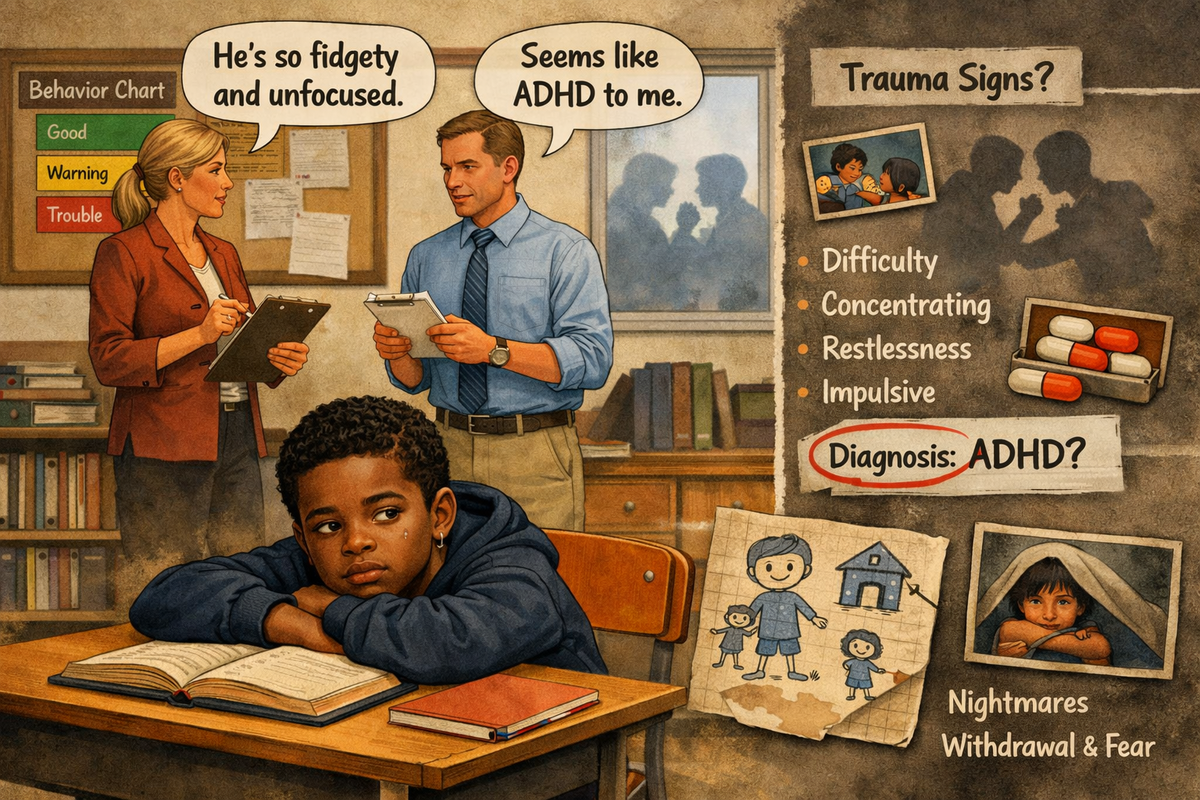
Research across psychology, education, and child development shows a consistent pattern: minority children, especially Black children, are disproportionately diagnosed with Attention‑Deficit/Hyperactivity Disorder (ADHD). However, many behaviors labeled as ADHD strongly overlap with symptoms of trauma, environmental instability, and chronic stress. This section reviews established research demonstrating how trauma is frequently misinterpreted as ADHD in minority youth, leading to inaccurate diagnoses and inappropriate treatment.
Trauma Symptoms That Resemble ADHD
Scientific literature clearly documents that trauma can produce behaviors identical to ADHD, including:
● Hypervigilance
● Restlessness or fidgeting
● Difficulty concentrating
● Impulsivity
● Emotional reactivity
● Trouble following directions
These behaviors are adaptive survival responses, not signs of a neurodevelopmental disorder. Children exposed to violence, instability, or unpredictable environments often remain in a heightened state of alertness, which clinicians may mistake for ADHD (García‑Arch et al., 2022).
Minority Children Experience Higher Trauma Exposure
Research shows minority children face significantly higher rates of:
● Poverty
● Community violence
● Housing instability
● School discipline disparities
● Racial discrimination
● Family stress linked to systemic inequities
These conditions increase trauma exposure, making trauma‑related hyperarousal more common in Black and Hispanic youth. When trauma is widespread, misdiagnosis becomes more likely. Racial Disparities in ADHD Diagnosis Morgan et al. (2013) found clear racial and ethnic disparities in ADHD diagnosis from kindergarten through eighth grade. Their findings show:
● Black children are more likely to be labeled “disruptive” or “hyperactive.”
● Teachers refer minority children for behavioral evaluation at higher rates.
● Clinicians diagnose ADHD more frequently in minority children, even when symptoms overlap with trauma indicators.
This demonstrates that diagnostic decisions are influenced by racial bias and environmental misunderstanding.
How Trauma Gets Misread as ADHD
Teacher Interpretation Teachers often initiate ADHD referrals. Without trauma‑informed training, they may misinterpret:
● Hypervigilance as impulsivity
● Emotional withdrawal as inattentiveness
● Restlessness as defiance
● Startle responses as behavioral problems
These misinterpretations disproportionately affect minority children, who are already subject to harsher discipline and surveillance. Clinical Bias Haig (2019) explains that clinicians frequently rely on cognitive shortcuts. When minority children present with restlessness or difficulty focusing, these behaviors may be interpreted through racialized assumptions rather than contextual understanding.
Systemic Pathologizing of Black Childhood
Black children’s behavior is often judged outside of its social context. Trauma responses are framed as disorders rather than reflections of lived conditions. Pan‑African Scholarly Perspectives Pan‑African scholars have long critiqued how Western psychology interprets Black behavior:
● Amos Wilson (1991) argued that Black children’s behavior is judged without understanding the conditions that produced it.
● Frances Cress Welsing (1991) emphasized that Black behavior is pathologized through biased systems.
● Frantz Fanon (1952) described how oppressed people are framed as the problem rather than victims of structural conditions. These perspectives align with modern research showing that trauma in minority children is frequently misdiagnosed as ADHD.
Consequences of Misdiagnosis
Misdiagnosing trauma as ADHD has serious long‑term effects:
● Children may receive stimulant medication instead of trauma‑focused care.
● Trauma remains untreated, worsening emotional and behavioral outcomes.
● Children internalize the belief that they are “disordered.”
● Schools escalate discipline rather than provide support.
● Families may be pressured into accepting psychiatric labels without a full evaluation. This pattern reinforces systemic inequities and contributes to the pathologizing of Black childhood.
Why the Scientific Method Is Essential
Non‑scientific approaches, such as intuition, authority, anecdote, and pseudoscientific online tests, often lead to oversimplified or inaccurate conclusions. In contrast, the scientific method:
● Uses validated diagnostic tools
● Controls for confounding variables like trauma
● Relies on systematic observation
● Produces objective, repeatable data Haig (2019) emphasizes that scientific rigor is necessary to identify when trauma is being ignored in diagnostic processes.
Conclusion
The research is detailed: minority children are frequently misdiagnosed with ADHD when their behaviors reflect trauma, environmental stress, or racialized experiences. This misdiagnosis is rooted in biased frameworks, unequal trauma exposure, and systemic misunderstanding of Black childhood behavior. Recognizing trauma as the underlying cause is essential for developing culturally grounded, trauma‑informed practices that honor the lived experiences of minority youth.
References
García‐Arch, J., Ballestero‐Arnau, M., Hoyas, L. P., & Giaiotti, F. (2022). Disproven but still believed: The role of information and individual differences in the prediction of topic‐related pseudoscience acceptance. Applied Cognitive Psychology, 36(2), 268–282. Haig, B. D. (2018). The importance of scientific method for psychological science. Psychology Crime and Law, 25(6), 527–541. Morgan, P. L., Staff, J., Hillemeier, M. M., Farkas, G., & Maczuga, S. (2013). Racial and ethnic disparities in ADHD diagnosis from kindergarten to eighth grade. Pediatrics, 132(1), 85–93. Wilson, A. (1991). Black-on-Black Violence: The Psychodynamics of Black Self-Annihilation in Service of White Domination. Welsing, F. C. (1991). The Isis Papers: The Keys to the Colors. Fanon, F. (1952). Black Skin, White Masks.
Posted: Fri, Jul 17